
WISMO Tickets: How Shopify Brands Cut "Where Is My Order?" Emails in Half
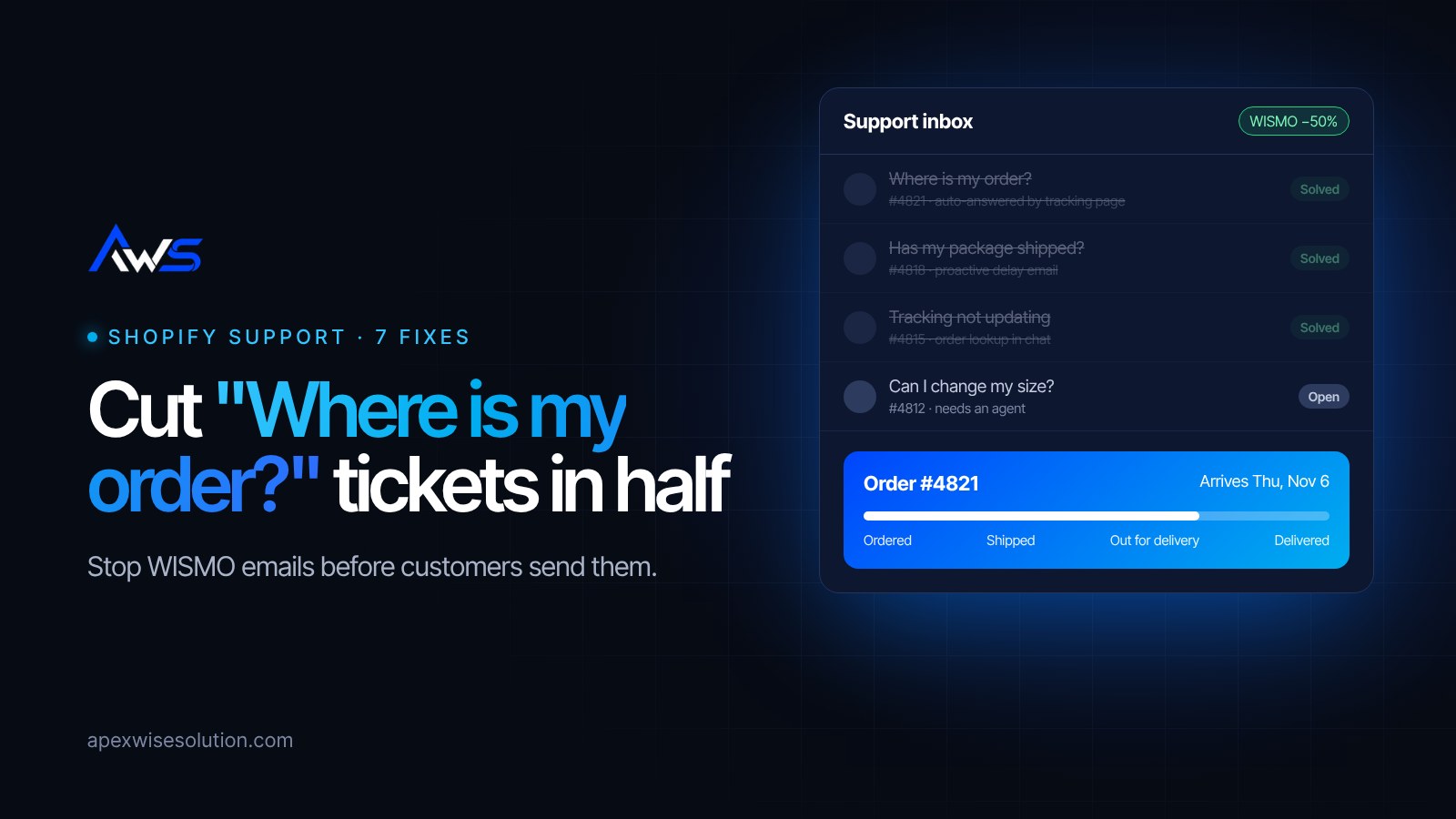
Ask any Shopify support team what fills their inbox and you will hear the same answer: "Where is my order?" These tickets, known as WISMO, often make up 30 to 50 percent of all customer messages for an online store, and they spike every time a carrier slows down or a holiday sale ships late.
The frustrating part is that most WISMO tickets are avoidable. The customer is not angry yet. They just do not know where their package is. Give them that answer before they ask, and the ticket never gets written.
Here are seven fixes that work for US ecommerce brands, in the order we usually set them up for clients.
1. Put a branded tracking page on your own site
When the shipping confirmation links straight to a carrier website, customers see cryptic scan codes like "In transit, arriving late" and they write in. A branded tracking page on your store shows the same data in plain language, with an estimated delivery date, your return policy and a few product recommendations.
Apps such as AfterShip, Route, Parcel Panel and Wonderment all do this. Pick one, link it from the order confirmation email, the shipping email and your site footer, and add a "Track my order" link to your main menu.
2. Show an estimated delivery date before checkout
A lot of WISMO tickets come from expectations that were never set. If the product page and cart say "Arrives by Thursday, Nov 6," the customer has a date to hold you to, and they will not email on day three asking where it is. Show processing time and shipping time separately so nobody thinks "ships in 2 days" means "arrives in 2 days."
3. Send proactive delay emails
If an order has not shipped within your stated processing time, or a tracking number has not updated in 72 hours, email the customer before they email you. A short message that says "Your order is running two days behind. Here is the new date, and here is a 10 percent code for the wait" turns a complaint into goodwill.
Most tracking apps can trigger this automatically based on exception events. Set it up once and it runs every day.
4. Rewrite your shipping confirmation email
The default Shopify shipping email is fine, but it buries the important part. Move the tracking link and the expected delivery date to the top in a large button. Add one line about what to do if tracking does not update for a few days, which is normal for the first 24 to 48 hours.
5. Answer order status in live chat and help center automatically
If you use Gorgias, Re:amaze or Zendesk, connect it to Shopify so the chat widget can show order status when a customer enters their email or order number. Add a "Where is my order?" article to your help center with the steps to find tracking and the most common reasons a package looks stuck.
This will not remove every ticket, but it catches the customers who are happy to self-serve.
6. Build a fast macro for the tickets that still come in
Some customers will always write in. For those, your agents need a macro that pulls the order's tracking link, carrier and last scan straight into the reply. The goal is a one-minute answer that does not need the agent to open three tabs. In Gorgias, variables like the order's tracking URL make this easy.
Write a few versions: one for "in transit, on time," one for "delayed," one for "delivered but customer says not received." The last one needs a different process, which brings us to the next point.
7. Have a clear policy for "delivered but not received"
These are the expensive WISMO tickets because they end in a reship or refund. Decide your rules in advance: ask the customer to check with neighbors and their mailbox, wait 24 to 48 hours, then file a carrier claim or reship based on order value. When agents follow one policy, customers get faster answers and you stop paying for reships that were not needed.
What results to expect
Brands that set up a branded tracking page, proactive delay emails and order lookup in chat usually see WISMO volume fall by a third to a half within a month. The remaining tickets get answered faster because the macros do the heavy lifting.
That matters most in Q4. When order volume doubles over Black Friday and Cyber Monday, a support team that is not buried in "where is my order?" has time for the conversations that save sales: sizing questions, product comparisons and unhappy customers who need a real person.
Need help with the tickets that are left?
Apex Wise Solutions gives US Shopify brands trained support agents who work inside your helpdesk, around the clock. We set up the macros and tracking workflows above as part of onboarding, then handle WISMO, returns and pre-sale chat so your team can focus on growth.
Try a trained agent on your live tickets for a free pilot week, or read our 10 Gorgias tips to cut first response time.