
Does Your Small Business Need a Website in 2026? 8 Reasons the Answer Is Yes
Plenty of small business owners get by without a website. Customers find them on Facebook, through a Google listing or by word of mouth, and the phone keeps ringing. So it is a fair question: in 2026, do you actually need a website?
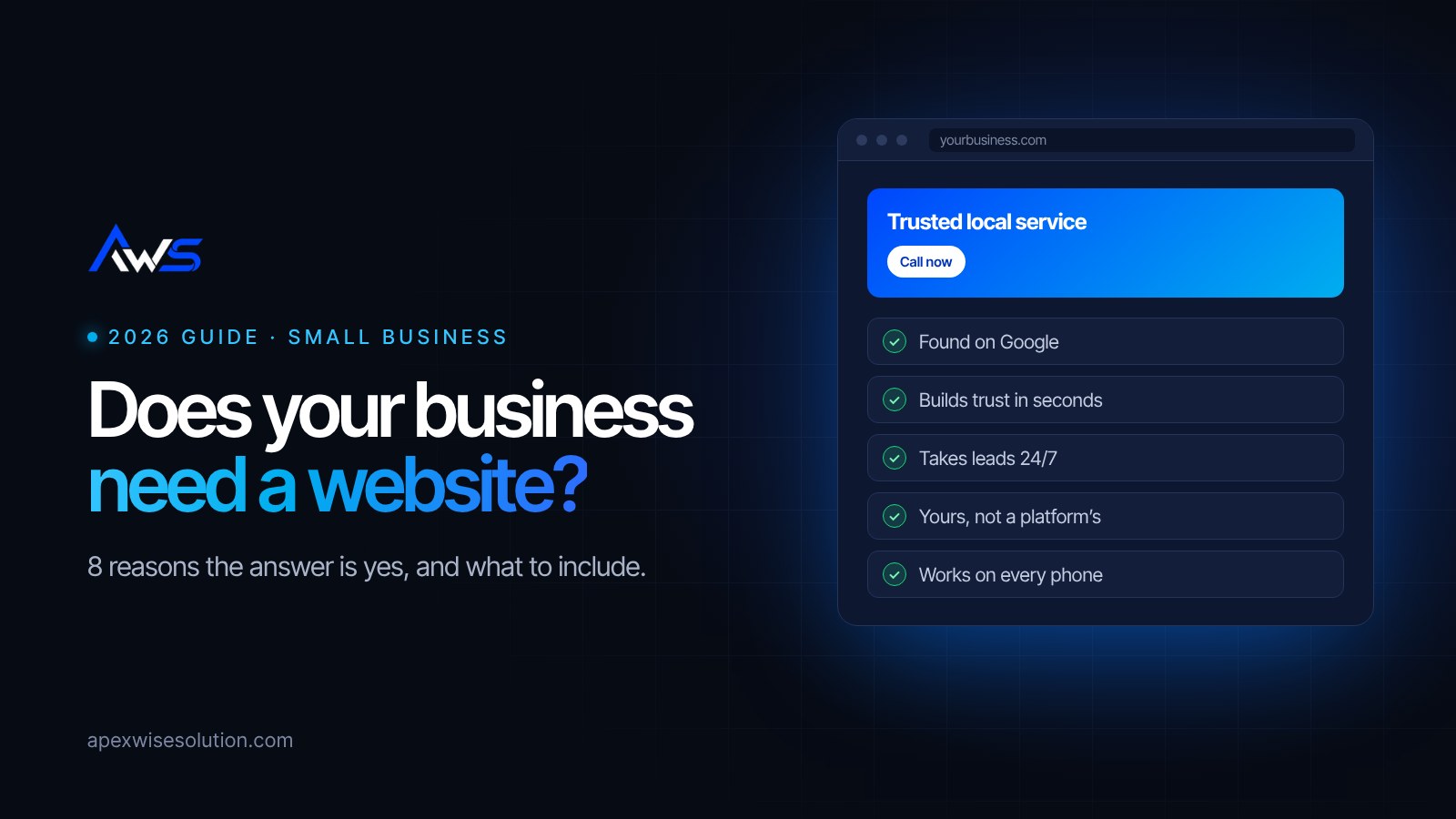
For almost every local business and online store, yes. Not because it is "expected", but because a website does several jobs that social profiles and directory listings cannot. Here are eight of them, followed by what a small business website should include.
1. People check you out before they call
Even a customer who heard about you from a friend will usually look you up first. They want to see your work, your prices or your service area before they pick up the phone. If the search turns up nothing but an old Facebook post, many of them move on to a competitor who looks more established.
A clean website answers their questions in a minute and makes the decision to contact you an easy one.
2. You own it
Your Facebook page, Instagram account and marketplace profiles all live on someone else's platform. Algorithms change, reach drops, accounts get restricted, and the rules can shift overnight. Your website and your domain belong to you. Everything else can point back to it.
3. It helps you show up on Google
When someone searches "plumber near me" or "best dentist in Austin", Google looks at your Google Business Profile, and it also looks at the website linked to it. A site with clear service pages, your location and your contact details gives Google far more to work with than a listing on its own.
Without a website, you are relying on a single profile to compete against businesses that have both.
4. It works while you are busy
You cannot answer the phone in the middle of a job, a consultation or a busy service. A website keeps working: it answers common questions, shows your hours, takes quote requests and lets people book. Leads that arrive at 11pm are still waiting for you in the morning.
5. It builds trust you cannot fake
Real photos of your work, reviews, the names of the people on your team, licences and guarantees all sit naturally on a website. They turn a stranger into someone who feels comfortable paying you. A business without a site, or with one that looks ten years old, quietly raises doubts.
6. It makes every other channel work better
Ads, flyers, vehicle wraps, social posts and email all need somewhere to send people. Sending them to a page built for that offer, with a clear button to call or book, converts far better than sending them to a busy social feed.
7. It answers the same questions so you don't have to
"Do you serve my area?" "How much does it cost?" "Are you open on Saturday?" A good FAQ and clear service pages answer these before the call, so the conversations you do have are with people who are already a good fit.
8. It is cheaper than you think
A professional small business website no longer means a huge agency bill. A focused site of five to eight pages, built properly and fast on mobile, is usually a one-time cost followed by a small monthly fee for hosting and care. Compared with the value of even one or two extra customers a month, it pays for itself quickly.
What a small business website should include
You do not need dozens of pages. You need the right ones, done well:
- A clear home page that says what you do, where, and for whom, in the first screen.
- One page per main service, so each one can rank on Google for its own searches.
- About page with real photos of you and your team.
- Reviews and examples of your work.
- Contact page with phone, email, a simple form, your hours and service area.
- Click-to-call buttons on mobile, because most local visitors are on their phones.
- Fast loading and a design that works on every screen size.
- Basic SEO set up from day one: page titles, descriptions, a sitemap and a connection to Google Search Console.
Common mistakes to avoid
- Building it and forgetting it. Old prices, old hours and a copyright year from 2019 make people wonder whether you are still open.
- Hiding the phone number. Put it at the top of every page.
- Stock photos everywhere. Real photos of your work and team build far more trust.
- Ignoring mobile. If the site is hard to use on a phone, most of your visitors will leave.
- No way to measure it. Set up analytics so you can see how many people visit and how many get in touch.
The bottom line
Social media and directory listings are useful, but they work best as signposts pointing to a website you own. In 2026, a simple, fast, well-structured site is one of the most reliable ways for a small business to look credible, get found on Google and turn interest into calls.
At Apex Wise Solutions we build fast, mobile-first websites for small businesses and online stores, with SEO set up from the start. If you are not sure whether your current site is helping or hurting, ask us for a free website review and we will tell you honestly what to fix first. You can also see everything we do on our services page.